
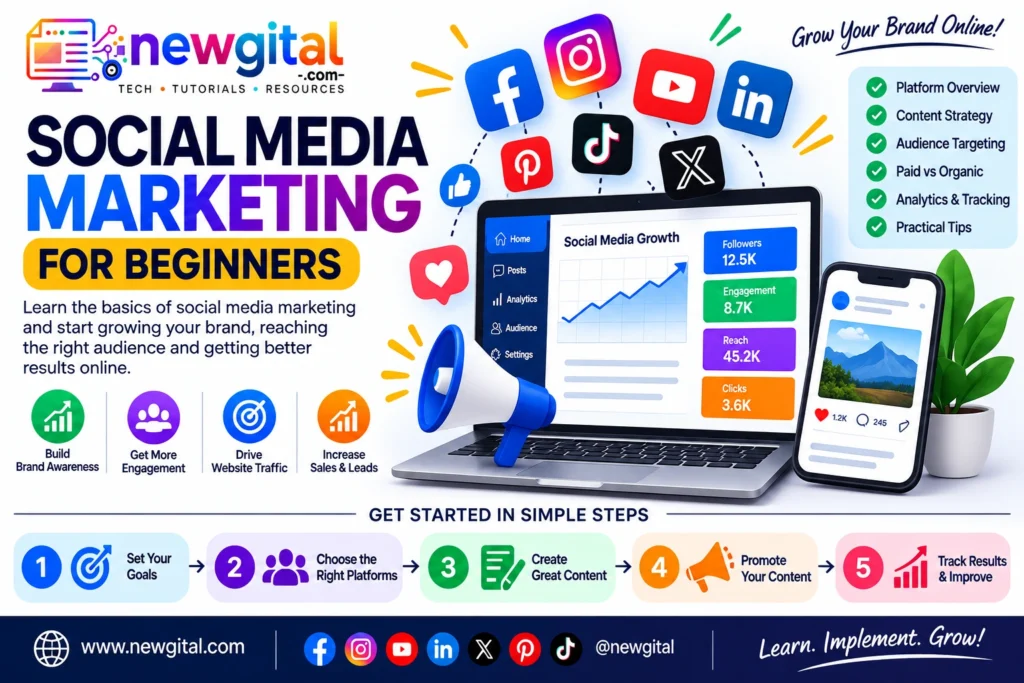
What Is Social Media Marketing?
Social media marketing is the use of social networking platforms to communicate with an audience and achieve specific marketing goals.
Businesses can use social media to:
- Increase brand awareness
- Reach potential customers
- Build relationships with existing customers
- Share educational or entertaining content
- Drive traffic to a website
- Generate leads
- Promote products or services
- Support customer service
- Increase sales and conversions
- Build a community around a brand
Social media marketing can include both organic marketing and paid advertising.
Organic social media marketing involves publishing content and engaging with users without directly paying for distribution.
Paid social media marketing involves advertising through a platform’s paid advertising system to reach selected audiences.
Both approaches can be useful, but they serve different purposes and should be measured separately.
Social media marketing is the process of using social media platforms to promote a business, build a brand, connect with customers, and generate website traffic, leads, or sales.
For beginners, social media marketing can seem overwhelming because there are many platforms, content formats, algorithms, advertising options, and analytics tools. The good news is that you do not need to be active everywhere or create complicated campaigns to get started.
A successful social media strategy begins with understanding your audience, choosing the right platforms, creating useful content, publishing consistently, engaging with your audience, and measuring results.
How Does Social Media Marketing Work?
A basic social media marketing process looks like this:
Research → Set goals → Choose platforms → Create content → Publish → Engage → Measure → Improve
Each stage supports the next one.
For example, if your goal is to generate leads for a software company, you might publish educational content that solves problems faced by your target customers. You can then direct interested users to a landing page and measure how many qualified leads the campaign generates.
The strategy should therefore connect social media activity with a measurable business objective.
Step 1: Define Your Target Audience
Before creating content, identify who you are trying to reach.
Your target audience may be defined by factors such as:
- Age
- Location
- Profession
- Industry
- Interests
- Problems
- Buying behavior
- Business size
- Experience level
- Purchasing needs
For example, a company selling website development services to small businesses should not create exactly the same content as a brand selling gaming accessories to teenagers.
Step 2: Set Social Media Marketing Goals
Followers can be useful, but follower count alone does not tell you whether your marketing is successful.
Instead, establish specific goals such as:
- Generate 50 qualified leads per month
- Increase website traffic from social media
- Improve engagement with educational content
- Increase product inquiries
- Generate online sales
- Increase brand awareness within a target audience
Step 3: Choose the Right Social Media Platforms
You do not need to use every social media platform.
Choose platforms based on where your target audience spends time and what type of content you can consistently produce.
| Platform | Common Strengths | Potential Content |
|---|---|---|
| Communities, businesses, broad audiences | Posts, videos, groups, ads | |
| Visual content and creator-focused communication | Reels, Stories, images, carousels | |
| Professional and B2B audiences | Articles, posts, documents, video | |
| YouTube | Video education and discovery | Tutorials, reviews, explainers |
| TikTok | Short-form video discovery | Short videos, educational clips |
| Visual discovery and planning | Pins, guides, product content | |
| X | Public conversations and timely updates | Short posts, discussions, links |
How Many Platforms Should Beginners Use?
Start with one or two platforms where your target audience is relevant.Step 4: Create a Social Media Content Strategy
Your content strategy defines what you will publish, for whom, why, and how often.
A simple strategy can use several content categories.
Content Categories
1. Educational Content
2. Entertaining Content
3. Promotional Content
4. Community Content
Step 5: Choose the Right Content Formats
Different platforms support different formats.
Common Formats
 1. Short-form videos
 2. Long-form videos
 3. Images
 4. Carousels
 5. Text posts
 6. Stories
 7. Live streams
 8. Polls
 9. Articles
10. User-generated content
For example, a small business that cannot produce high-quality video every day can start with useful images, carousels, text posts, or simple videos.
Step 6: Build a Social Media Content Calendar
A content calendar helps you organize publishing. You can create a simple spreadsheet with columns such as:
| Date | Platform | Topic | Format | Objective | Status |
|---|---|---|---|---|---|
| Monday | Beginner SEO Tips | Carousel | Education | Scheduled | |
| Tuesday | Industry Mistakes | Text | Engagement | Draft | |
| Wednesday | YouTube | SEO Tutorial | Video | Traffic | Planned |
| Friday | Product Demo | Reel | Conversion | Planned |
Step 7: Write Better Social Media Posts
A good social media post should communicate its main idea quickly. A simple structure is: Hook → Value → Call to Action
CTA Examples
* Read the complete guide
* Visit our website
* Save this post
* Share your experience
* Download the checklist
* Contact us for more information
Step 8: Engage With Your Audience
Social media marketing is not only about publishing. Engage with people who:
- Comment on your posts
- Ask questions
- Mention your brand
- Send messages
- Share your content
- Provide feedback
Respond professionally and use conversations to understand your audience better. Customer questions can also provide ideas for future content.
For example, if several customers ask how to configure a particular product, that question could become a tutorial, video, FAQ post, or knowledge-base article.
Step 9: Use Hashtags Carefully
Hashtags can help categorize content on platforms that support them, but using large numbers of unrelated hashtags is not a substitute for good content. Use hashtags that are genuinely relevant to the topic, brand, industry, or audience.
For example, a post about beginner SEO could use relevant terms such as:
- #SEO
- #DigitalMarketing
- #SEOTips
- #ContentMarketing